*This is, admittedly, something I wrote awhile ago but I felt like it was worth posting.
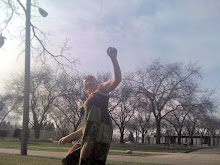
It’s a beautiful fall day and I’ve invited several friends from the homeschooling group we’re part of to come over and play in our yard. My 7-year-old son is chasing my 10-year old daughter and her friend around our yard as they squeal in delighted terror. This isn’t going well so the girls decide to start an army to defeat my son and his friends. My son is not enjoying being the object of their attack so we all work together to create two teams that will battle each other by fencing with sticks. Interestingly, and not by adult design, the teams consist of one group of four girls and one boy and another of four boys and one girl.
This is not the first time they’ve constructed a scenario to be played out--the last time we were all together at a local park, they had created a kingdom with hunters and gatherers and wizards, everyone playing a part. From our adult vantage point, it looked like they were all climbing on a big tree trunk but when we peeked into their world, for whatever reason, we discovered something much more complex, imaginative and purposeful.
While all of the parents in our group have different styles of homeschooling (from highly structured to unschooling) we all agree on one thing—the importance of letting kids have time to be kids. Imaginative play and connecting with nature are things we encourage and see actively in our children and are aspects of education and child-rearing that sometimes get lost in today’s world.
While studying education years ago, before I had children, I remember reading about the importance of imaginative play, not just in toddlers or very small children but in older children as well. Among other things, role-playing helped kids develop empathy, since they were more easily able to put themselves in someone else’s shoes. It also helped nurture an ability to find creative ways to problem-solve and think outside the box (like using a stick as a sword or a banana for a phone). Surely these things are not only useful but necessary for all of us and imaginative play is most certainly underestimated or overlooked compared to reading, writing, testing and the like.
Parents with kids in school tell me that kindergarteners are doing worksheets and homework, and that children in elementary school are developing anxiety disorders due to the stress and increased pressure to excel academically and the amount of work being given. Add to this the reduction in recess or free time and we’ve got a recipe for children who might be successful in their academic or professional lives, but disconnected from each other and the natural world around them.
I have been heartened to see my 5-year-old daughter building a nest out of twigs and leaves for herself and her “baby bird” (another 5-year old) after observing a mother and baby robin or to see my 10-year-old daughter rushing to the computer to look up anything she can on painted turtles so that she can find out how (if at all) to help the baby she found in the driveway. These aren’t things that can be taught, they must be experienced and their value must not be underestimated. Without empathy, how can we become a more peaceful society? Without imagination, how can there be innovation?
So today, while the kids march off with sticks in hand for hours, I am confident that they will do more than just hit sticks together…rules will be made, alliances formed, ideas played out. Play is never just play. It is, as Albert Einstein says, “the greatest form of research.”
Showing posts with label homeschooling. Show all posts
Showing posts with label homeschooling. Show all posts
Thursday, February 18, 2010


Wednesday, February 17, 2010
Authentic Learning/Unschooling
For me, unschooling is a natural fit for leading an authentic life. Unschooling looks different in every family simply because it is guided and defined by the individuals that make up that family, including the children. The basic concept is that learning happens naturally, through living life. It doesn't have to be separated from life or institutionalized.
Today, for example, I was making granola with my 5-year-old daughter. I've done a lot of baking with my kids and math and chemistry are naturally embedded in the activity. I think my eldest learned fractions primarily from using the various measuring cups and spoons. But today, we got a lesson in physics, as well. Sadie was stirring the honey and oil together with a spoon. The bowl was metal and she wasn't holding onto it.
"Mom, look at this!" she squealed. Since she wasn't holding onto the bowl, the spoon was spinning that rather than the ingredients. "Look how high it can get!" she noticed. The faster she spun, the higher the liquid rose on the side of the bowl, leaving almost nothing at the bottom.
I'm not a scientist and I remember very little from my science classes in high school so I had to look up the word and definition for what I was seeing. Sadie could care less about that. They say that a picture is worth a thousand words, but an experience is worth even more.
My ten-year-old daughter is trying to find local horse rescues on the computer. She tends to like for me to give her direction so when she came to me feeling bored and wanting something to do, that's what I suggested because I know she wants to volunteer at a rescue and I haven't gotten the chance to look it up yet.
As I'm sitting and writing this, I'm watching my practically-eight-year-old son making a diving board off of our couch using his fort-building kit (pieces of peg board, posts with holes, screws, nuts and bolts.) He's figured out how to support the front but is still working on how to stabilize the back when weight is put on the front. He's used ropes but it's still not quite stable. Now he's got a back-up plan: pillows and blankets at the bottom. He's decided it will be more like a dunk tank (which he and his dad made this summer) than a diving board. And the experiment continues with his sisters getting in the act, too. It works as a diving board only if someone holds the back end down. Ari has used several layers of pegboard for the diving platform to prevent it from breaking.
I could categorize all the various lessons the kids are learning from this exercise or any of the other activities from our daily lives. But there's no need. It is organic learning, experiencing, living and they will retain and use and build on whatever is authentic and meaningful to them.
Authenticity begins young. I think we come into the world as authentic beings and our experiences during our formative years help to determine our connection to our authentic self. School age has gotten younger and younger, there are fewer recesses, more expectations, less time to play and be children. I would hazard a guess that all that this does is lead to delayed childhood, adults acting out their unfinished development in sometimes subtle, sometimes obvious ways.
Learning doesn't have to be compulsory and by making it so, we take the ownership of that learning away from our kids. As a society we tell them what to learn, when to learn it and how to learn it and if the schools' formula doesn't fit the child, too bad. Unschooling gives the ownership of learning back to the individual child. He/she seeks out what is interesting, stimulating, enjoyable. As a parent, I'm not a teacher, necessarily, but a facilitator, a guide, a partner in that learning. I try to provide a variety of resources and exposure to different things but I don't force them to learn anything or provide external motivation (ie: positive or negative reinforcement) for them to learn. I don't need to. All I need to do is open my eyes and my mind and see that they are learning every day, every minute. They are either learning from what they are experiencing in their physical world or they are learning from going inward, reflecting, imagining.
But I can't judge what they learn or the ways in which they learn because it is theirs and it is authentic to them. It is driven by them and I am there to support and nurture and validate their experience, not to create an experience for them that I think will result in their success or intelligence or whatever other expectation one might have. Sure, I want them to be successful out in the world but I don't define that success--they do. And above all, I want them to know themselves. That is the best education of all.
Subscribe to:
Posts (Atom)